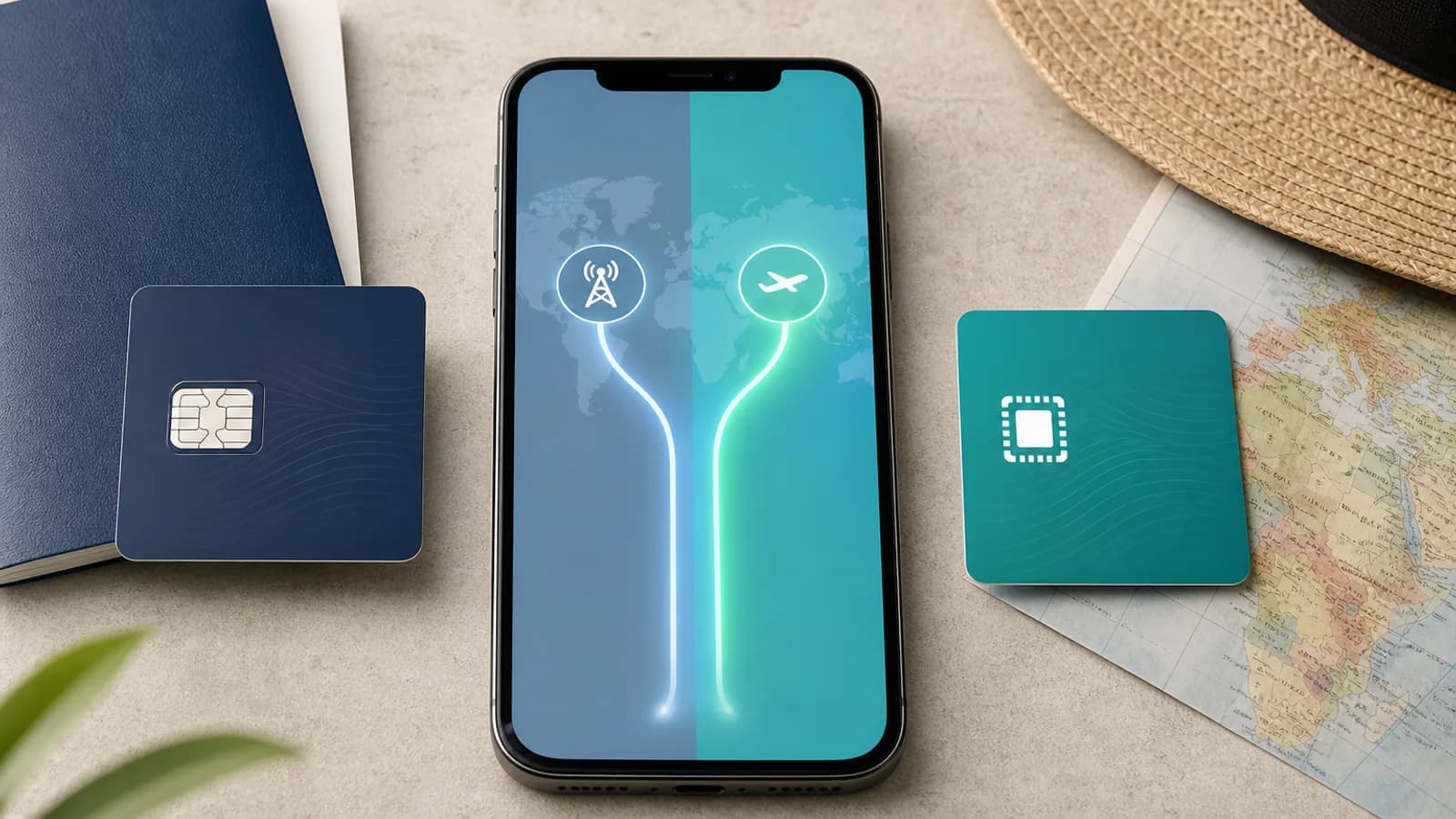
Travel Data Plans for Canadians: eSIM vs Roaming Pass
TL;DR
A clear comparison of carrier roaming passes and travel eSIMs for Canadians, with a decision guide for short trips, multi-country travel, and data-only use.
For Canadians travelling abroad, a travel data plan usually means extending your home carrier’s service with a roaming pass or adding a trip-specific eSIM for destination data. Both can get your phone online outside Canada, but they work differently: a roaming pass extends your Canadian service under your carrier’s international terms, while a travel eSIM adds a separate mobile-data line on a supported network.
Neither option is automatically best. The decision depends on whether you need your Canadian number, how much data you expect to use, how many countries you will visit, and how much setup you are willing to do.
This guide focuses on the practical purchase decision between a carrier pass and a trip-specific eSIM.
Ready to compare prepaid options? Browse current country, regional, and global travel eSIM plans or estimate your trip's usage with the data calculator. Check the selected plan's coverage, data allowance, and validity; Voyaio eSIM plans provide mobile data only.
Quick comparison
| Question | Canadian roaming pass | Travel eSIM |
|---|---|---|
| Uses your existing Canadian line? | Usually yes | Usually no; it adds a separate line |
| Traditional calls and texts | Often included according to carrier terms | Often data-only; check the plan |
| Canadian number | Stays central to the service | Can often remain available through dual SIM |
| Setup | Usually simple to add through the carrier | Install and configure before or during travel |
| Device requirement | Works with the carrier line and destination roaming | Requires a compatible, unlocked eSIM device |
| Multi-country flexibility | Depends on the pass and carrier rules | Depends on country, regional, or global coverage |
| Billing | Appears through the Canadian carrier | Paid separately from the Canadian bill |
| Main risk | Unexpected roaming or pass terms | Wrong coverage, settings, or insufficient data |
Carrier offerings, eligibility, included services, and prices change. Check your carrier’s current terms before relying on a pass, and do not use an old price comparison as a purchasing decision.
Choose a roaming pass when convenience matters most
A roaming pass may be the better fit when:
- You want to keep using your Canadian number with minimal setup.
- You need regular voice calls or carrier SMS rather than data-app calling.
- Your trip is short and your carrier’s terms fit your expected use.
- You want one provider to handle service questions and billing.
- Your phone does not support eSIM or is still carrier-locked.
The convenience can be meaningful on a short business trip, especially when missing a call or verification text is more costly than managing a second line. Still, read what counts as a roaming day, which destinations are included, what happens after an allowance is used, and whether tethering is permitted.
Choose a travel eSIM when data control or flexibility matters
A travel eSIM is often a good match when:
- Your main need is mobile data for maps, messaging, email, and travel apps.
- You want to keep foreign data separate from your Canadian plan.
- You are visiting several countries and a regional or global plan fits the route.
- You want to compare a plan for the trip length and expected data use.
- You have a compatible, unlocked phone and can install a second line.
Travel eSIMs are commonly data-only. That does not mean you lose every way to communicate: messaging, video calls, and many calling apps work over data. It does mean you should not assume the eSIM includes a local phone number or ordinary SMS. Read what travel eSIMs include for calls and texts before you buy.
What happens to your Canadian number?
Many compatible phones support dual SIM, allowing a travel eSIM to provide data while the Canadian line remains available for selected calls or texts. The exact experience depends on the phone and carrier. Keeping the Canadian line active can also create roaming exposure if it is allowed to use mobile data or if you answer calls under chargeable terms.
Before travelling, decide deliberately:
- Which line provides cellular data?
- Is data roaming off on the Canadian line?
- Do you need incoming SMS for banking or account verification?
- Do you need to make or receive ordinary calls?
- Will Wi-Fi Calling remain enabled, and what does your carrier say about it abroad?
The dual-SIM Canadian-number guide and phone-settings checklist cover these choices. A travel eSIM is not a guarantee that every Canadian service behaves exactly as it does at home.
Cost control without relying on outdated prices
The useful comparison is not only the advertised price. Compare the rules behind it:
- Is billing triggered by a calendar day, a 24-hour period, or usage?
- Is data capped, slowed, or charged separately after the included amount?
- Are calls, texts, hotspot, and voicemail treated differently?
- Does the option cover every country on the itinerary?
- Does the plan expire after a set number of days?
- Can you monitor usage easily?
Daily roaming rates were rechecked on Oct 22, 2026 against Rogers' Roam Like Home FAQ, Bell's Roam Better options, and TELUS Easy Roam. The published Canadian-dollar daily rates are CA$16 in the U.S. for Rogers and TELUS, and CA$13 in the U.S. for Bell; for eligible international destinations, Bell lists CA$16/day and TELUS lists CA$18/day, while Rogers gives Germany as a CA$18/day example. These are examples of each carrier's daily roaming option, not a quote for every account or trip. Eligibility, destination lists, plan inclusions, and charging triggers vary; bundled plans or multi-day passes can change the comparison. Confirm current terms for your line and itinerary before relying on a rate. See Voyaio's current USA, Mexico, and Europe comparisons. Voyaio plans provide mobile data only.
What is the difference between pay-per-day roaming and a monthly add-on?
Pay-per-day roaming charges a daily fee on eligible days you use your phone abroad, under your carrier's rules. A Travel Pass is a separate add-on for a fixed duration; it can use allowances from your existing plan and may replace the daily roaming fee while active in an eligible destination. A “30-day” pass is fixed-term, not automatically a recurring monthly plan. As checked Oct 22, 2026, Rogers lists 3-, 7-, 14-, and 30-day Travel Passes, Bell offers an international 30-day Travel Pass, and TELUS lists 3-, 7-, 14-, and 30-day Travel Passes. Prices, destination eligibility, activation, included allowances, and expiry rules depend on the carrier and account. Check the full trip price in your carrier account before choosing. A Voyaio eSIM is a separately purchased, data-only plan, so compare its trip price and validity without treating it as a replacement for carrier calls or texts.
Roaming pass pricing varies by Canadian carrier and can change. Travel eSIM pricing also varies by destination, data amount, validity, and provider. Use current plan pages for the exact figure and use the data calculator to avoid buying based on a vague “unlimited” or “lots of data” assumption.
Setup effort: one tap vs one planned configuration
A roaming pass can feel simpler because your existing line remains the default. A travel eSIM takes a few more deliberate steps, but installing it before departure can make arrival easier:
- Check eSIM compatibility and whether the phone is unlocked.
- Install the travel line over Wi-Fi.
- Label the Canadian and travel lines clearly.
- Select the travel eSIM for mobile data when you arrive.
- Turn off data roaming on the Canadian line.
- Test maps or a message before leaving the airport.
If the eSIM does not connect, the issue may be installation, network selection, APN configuration, or coverage. The eSIM troubleshooting guide gives a practical checklist.
What about hotspot and work travel?
Do not assume that a roaming pass and a travel eSIM have identical hotspot rules. Check tethering terms for whichever option you choose. A laptop, tablet, or family member connected to your phone can consume data faster than ordinary phone use.
For remote work, also consider VPN compatibility, video meetings, upload speed, and a backup connection. A roaming pass may be convenient for keeping the Canadian number, while a travel eSIM may be useful as a separate data path. The hotspot guide explains the practical limitations.
Short trip, long trip, or multi-country itinerary?
Use the trip shape as a decision shortcut:
- Short, simple, one-country trip: A roaming pass may win on convenience; a country eSIM may win on data separation.
- UK-only trip: Compare the UK eSIM plan with your carrier's current roaming terms. Choose a Europe plan only if your route continues to countries listed on that selected offer.
- Longer stay: Compare the total validity and data terms rather than assuming daily roaming is best.
- Multi-country trip: Check whether the roaming pass covers every stop or compare a regional/global eSIM. Use the country, regional, and global comparison and verify each stop against the selected offer.
- Business travel: Prioritize the option your employer supports for VPN, calls, and security.
- Family travel: Compare one carrier line or one hotspot with separate data lines; the family hotspot guide explains the trade-off.
A note about cruises and aircraft
Neither a normal roaming pass nor a standard land travel eSIM should be assumed to provide ordinary terrestrial coverage in the middle of the ocean. Cruise ships may offer separate maritime cellular service or ship Wi-Fi, and aircraft have their own connectivity rules. Read the cruise eSIM coverage guide before treating a cruise itinerary as a normal multi-country trip.
Bottom line
Choose a roaming pass when keeping your Canadian service and number with minimal effort is the priority and the current carrier terms fit your trip. Choose a travel eSIM when data separation, destination flexibility, or predictable trip-specific planning matters more. Either way, verify coverage, included services, tethering rules, and the settings that prevent your Canadian line from using data unexpectedly. If a travel eSIM fits, compare Voyaio's destination plans for Canadians, including CA$ pricing and a U.S. roaming comparison.
Frequently asked questions
Is a roaming pass cheaper than a travel eSIM?
It depends on the current carrier price, trip length, data allowance, and destination coverage. Compare the total cost and included data for the exact dates instead of assuming either option is always cheaper.
Can I use a roaming pass and a travel eSIM together?
Yes, on a compatible dual-SIM phone. Select the travel eSIM for mobile data and keep the Canadian line available only for the services you intentionally need.
Which option is better for a multi-country trip?
Compare whether the roaming pass covers every country and whether a regional or global eSIM covers the full route. A single regional plan can be simpler when the itinerary crosses several borders.
Does a travel eSIM include my Canadian phone number?
Most travel eSIMs are data-only and do not replace your Canadian number. Your Canadian SIM can often remain in the phone for calls or verification texts, subject to carrier charges.