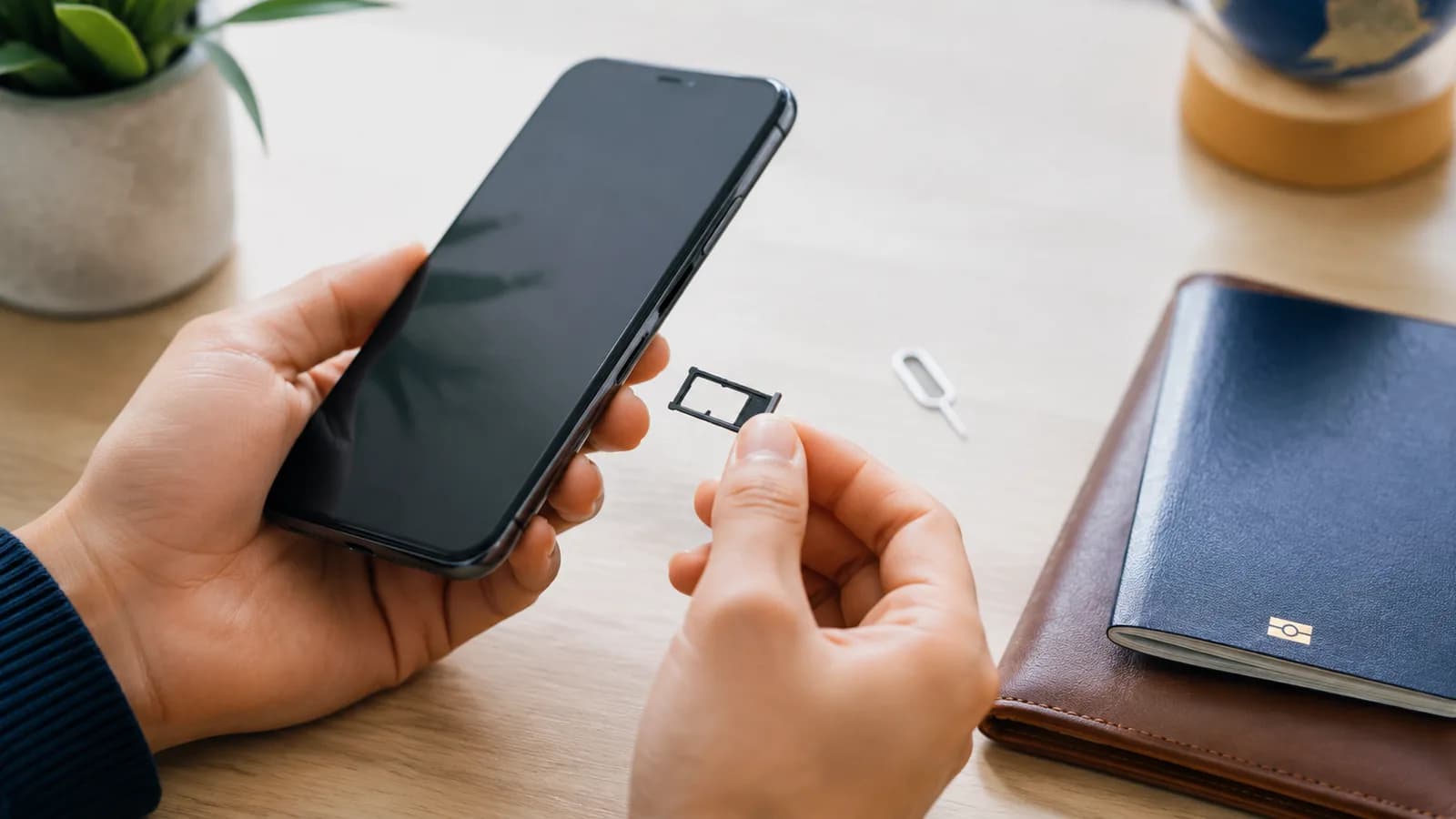
How to Tell If Your Phone Is Unlocked Before Using a Travel eSIM
TL;DR
Check iPhone and Android unlock status before travelling, understand carrier-lock messages, and avoid testing an eSIM on a restricted phone.
Your phone can support eSIM technology and still be unable to use a travel eSIM if it is locked to a carrier. An unlocked phone can accept service from different providers. A locked phone may reject a travel plan even when the eSIM QR code and installation steps are correct.
For Canadian travellers, checking unlock status before departure is one of the simplest ways to avoid an activation problem at the airport. It is separate from checking whether the phone supports eSIM; use the eSIM phone compatibility guide for the complete device checklist.
Quick answer
- On iPhone, open Settings > General > About and look for Carrier Lock or Network Provider Lock. No SIM restrictions means the iPhone is unlocked.
- On Android, there is no single unlock-status screen that works on every brand. The most reliable checks are your carrier account, your carrier's support team, or testing with a SIM from another provider.
- Do not buy a travel eSIM just to test a phone that may be locked. Confirm first, especially if the phone is used, refurbished, imported, or purchased outside Canada.
What “unlocked” means
An unlocked phone is not tied to one carrier's SIM or eSIM service. It can use a compatible plan from another provider, subject to eSIM support, network compatibility, and the plan's destination coverage.
Unlock status is not the same as:
- eSIM compatibility: whether the hardware and regional model can download an eSIM.
- Network coverage: whether the travel plan works in the country you are visiting.
- Blacklist or account status: whether a device is blocked because it was reported lost, stolen, or has another account issue.
- Band support: whether the phone supports the local network frequencies used by the plan.
All four can affect travel connectivity, so a phone that is unlocked is not automatically ready for every eSIM.
How to check an iPhone
Use the Carrier Lock setting
On the iPhone, open:
Settings > General > About
Scroll until you find Carrier Lock or Network Provider Lock.
- No SIM restrictions: the iPhone is unlocked.
- A message naming a carrier or saying the device is restricted: contact that carrier about the unlock.
- No lock field: update iOS if appropriate, check the exact model, or confirm with the carrier.
The wording can vary by iOS version and region, but No SIM restrictions is the clearest iPhone confirmation.
Test with another provider's SIM or eSIM
If the setting is unclear, use a working SIM from a different carrier. A physical SIM from a family member or a temporary provider test can be enough. Restart the iPhone and see whether it connects or displays a message such as SIM Not Supported.
A failed test can also be caused by an incompatible SIM, no coverage, or an account issue, so treat the message as a clue rather than the only proof.
Ask the carrier to confirm
Give the carrier the iPhone's IMEI or account details and ask them to confirm that the device is unlocked and eligible for another provider's SIM or eSIM. Use Settings > General > About to find the IMEI; do not post it publicly.
How to check an Android phone
Android does not have one universal label for unlock status. Settings differ between Google Pixel, Samsung Galaxy, Motorola, and other brands.
Start with your carrier account
Sign in to the carrier app or website and look for device, SIM, network lock, or unlock information. If the wording is unclear, contact the carrier and ask a direct question: “Is this exact phone unlocked and able to use another provider's SIM or eSIM while travelling?”
Have the phone's IMEI ready. You can usually find it under Settings > About phone, or by entering *#06# in the phone app. Keep the number private.
Test with another provider's SIM
Insert a physical SIM from a different carrier if your Android phone has a SIM tray. Restart the phone and check whether it registers on the network. A message such as SIM not supported, Network locked, or a request for an unlock code suggests a restriction.
On some Android phones, you can test with another provider's eSIM, but do not download a valuable travel plan just for this test. The phone must also support eSIM, and a failed download does not always prove that it is locked.
Check network settings carefully
Some Android models show network-operator or SIM information under Settings > Connections > Mobile networks, Settings > Network & internet > SIMs, or SIM manager. These screens can confirm that a SIM is detected, but they do not always prove the phone is unlocked. Carrier confirmation or a real alternate-SIM test is stronger evidence.
What Canadian travellers should know
Most phones sold directly by Canadian carriers today are sold unlocked, but that does not guarantee every phone in circulation is unlocked. Be especially cautious with:
- Used or refurbished phones.
- Phones bought from a private seller.
- Devices imported from another country.
- Older phones purchased before current Canadian carrier practices.
- Phones previously used with a business, family, or financing account.
The seller's description is not enough. Check the phone itself or ask the original carrier before you leave Canada.
If your phone is locked
Contact the carrier that locked the phone and ask about its unlock process. Do this while you still have access to your Canadian account, Wi-Fi, and support channels. Do not pay an unrelated website that promises to unlock the phone without first checking with the carrier.
If the phone cannot be unlocked in time, alternatives include:
- Using your Canadian carrier's roaming option.
- Buying a compatible unlocked phone before the trip.
- Using a local physical SIM after arrival with an unlocked backup phone.
- Relying on Wi-Fi and offline maps for a short trip.
Compare the tradeoffs in roaming pass vs travel eSIM for Canadians and eSIM versus a physical SIM.
Do this before buying a travel eSIM
Complete this short check at home:
- Confirm the exact phone model and region.
- Confirm that Add eSIM or a similar option appears in settings.
- Confirm iPhone Carrier Lock says No SIM restrictions, or get carrier confirmation on Android.
- Check that the destination is covered by the plan.
- Install the eSIM over Wi-Fi before leaving Canada when the plan instructions allow it.
Once you have an unlocked, compatible phone, follow the travel eSIM installation guide and label the travel line clearly.
Frequently asked questions
Does seeing “Add eSIM” mean my phone is unlocked?
No. It shows that the phone may support eSIM, but the device can still be carrier-locked.
Will a Canadian carrier unlock my phone?
Ask the carrier that supplied the device. Eligibility and the process can depend on the device, account, and carrier records.
Can I check unlock status without another SIM?
On iPhone, yes: Settings > General > About > Carrier Lock is the clearest check. On Android, use carrier confirmation or the carrier account when an alternate SIM is not available.
Is an unlocked phone guaranteed to work with a travel eSIM?
No. It must also support eSIM, the right regional hardware, compatible networks, and the destination covered by the plan.